

The Return of the Storks
Leyleklerin Dönüşü
Doğu Anadolu'da her yıl leyleklerin köye dönüşünü kutlayan bir topluluğun geleneği.
Altı noktalı kelimelere dokun, anlamı çıksın.
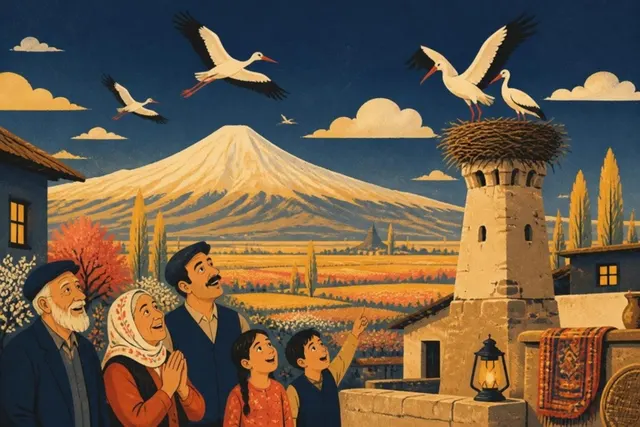
Every March, in a small village on the Iğdır plain near the Armenian border, an ancient ritual is repeated with remarkable precision. , having spent the winter months in Africa, return to the exact same they abandoned the previous autumn, and their arrival is celebrated by villagers as though it were an official holiday.
According to Mehmet Dede, the village's eldest resident, this tradition has been passed down for as long as anyone can remember. He was told by his own grandfather that storks were considered messengers, believed to bring good fortune to any household lucky enough to host a nest on its roof. Even today, families compete quietly to attract these birds, and rooftops are specially prepared each winter to encourage nesting.
This year, something unusual was reported by local wildlife researchers who had been monitoring the storks' migration patterns using satellite tracking devices. It was discovered that one particular stork, affectionately nicknamed "Kara Ayak" by villagers because of a distinctive dark marking on its leg, had been returning to the same rooftop nest for eleven consecutive years, an unusually long record even among these famously loyal birds.
Elmas, a young biology teacher who had recently moved to the village, was fascinated by these patterns and decided to organize an educational project involving her students. The children were asked to observe and document the storks' behavior throughout the nesting season, recording details such as feeding patterns, chick development, and eventual departure dates. It was explained to the students that storks typically remain , often returning to the same partner and nest location year after year, unless one of the pair fails to survive the long migration.
During a community gathering organized to welcome the birds' return, Mehmet Dede was asked by one curious child why the storks always seemed to arrive on almost exactly the same date each spring. He replied that his grandfather had once told him that storks possessed an internal calendar more precise than any human clock, guided by that scientists still couldn't fully explain, despite decades of dedicated research.
Unfortunately, this year's celebrations were briefly overshadowed by concerning news. It was reported that three nests had been unexpectedly destroyed during recent construction work along the village's main road, displacing several breeding pairs just before their anticipated arrival. Local authorities were quickly contacted, and it was promised that new nesting would be constructed immediately to accommodate the displaced birds.
Elmas's students, deeply affected by this incident, requested permission to help build replacement nesting structures themselves, guided by instructions provided by wildlife conservation experts who were consulted specifically for this purpose. Within two weeks, several new platforms had been successfully installed, and remarkably, two of the three displaced pairs were observed returning to these newly constructed alternatives.
By early summer, the village's rooftops were once again filled with the familiar sight of storks feeding their newly hatched chicks, their loud bill-clattering sounds echoing pleasantly across the plain. Mehmet Dede, watching proudly alongside Elmas and her students, remarked that this year's challenges had taught the younger generation something valuable about their responsibility toward these ancient visitors.
"These birds have been coming to us for hundreds of years," he told the gathered children, smiling warmly. "It was said by our that as long as storks continue choosing our rooftops, our village will always be considered a fortunate place. Perhaps that fortune, though, depends equally on how well we continue taking care of them in return."

Kelimeler
Hikayedeki 8 yeni kelime, hikayeden örnek cümleleriyle.
Storks return to the exact same nests each year.
Storks were considered sacred messengers.
Rooftops are prepared to encourage nesting.
Storks typically remain monogamous.
They are guided by instincts scientists can't fully explain.
Construction destroyed nests, displacing breeding pairs.
New nesting platforms would be constructed.
It was said by our ancestors.
Gramer notu
passive voice ve reported speech (karışık)
"Passive voice", eylemi kimin yaptığından çok sonucuna odaklanır; "reported speech" ise birinin sözlerini dolaylı olarak aktarır. Bu hikayede ikisi birlikte kullanılarak hem geleneğin anlatımı hem de karakterlerin konuşmaları verilir.
Örnekler:
- Their arrival is celebrated by villagers as though it were an official holiday.
- He was told by his own grandfather that storks were considered sacred messengers.
- It was promised that new nesting platforms would be constructed immediately.
Ne kadar anladın?
6 kısa soru. Cevabını seç, hemen doğrusunu gör.