


The Restoration of the Mosque
Selimiye Camii'nin Restorasyonu
Edirne'deki tarihi bir caminin restorasyon sürecinde karşılaşılan zorluklar.
Altı noktalı kelimelere dokun, anlamı çıksın.
For over four hundred years, the Selimiye Mosque has stood at the center of Edirne, admired by architects and historians from around the world. Last year, however, were discovered in one of the mosque's smaller domes, and a full restoration project was immediately approved by the local authorities.
The restoration was led by Deniz Hoca, a young architect who had studied Ottoman construction techniques extensively. She explained that the mosque was originally built using a combination of stone and specially prepared , a method that has rarely been used in modern construction. "If this building is going to be repaired properly," she said, "traditional materials must be used, even though they are much more expensive than modern alternatives."
Before any work could begin, detailed were conducted by a team of engineers. Every crack was photographed, and samples of the original stone were sent to a laboratory in Istanbul to be analyzed. It was discovered that the damage had been caused partly by earthquakes over the centuries and partly by pollution from nearby traffic, which had slowly weakened the exterior surface.
The project faced numerous challenges from the very beginning. Skilled who still knew the old techniques were extremely difficult to find, since this craft had almost been forgotten. Eventually, three elderly craftsmen were located in a small village near Bursa, where similar restoration techniques had once been practiced for generations. They were invited to Edirne and were asked to train a small group of younger workers during the project.
While the physical restoration was carried out, historical documents were also examined carefully by researchers, in order to understand exactly how the original builders had solved similar structural problems. Old Ottoman records were consulted, and it was confirmed that a nearly identical repair had been performed on a different section of the mosque almost two hundred years earlier.
Local residents were kept informed throughout the entire process. Public meetings were organized regularly, where questions from concerned citizens were answered directly by the architects. Many people in Edirne felt a personal connection to the mosque, since important family events, from weddings to funerals, had been held there for generations. "This building isn't just stone," one elderly resident said during a meeting. "It has been woven into every important moment of our lives."
Funding for the project was provided partly by the government and partly through private , which were collected from around the country. A special account was opened, and updates about the restoration's progress were published monthly on social media, allowing donors to see exactly how their contributions were being used.
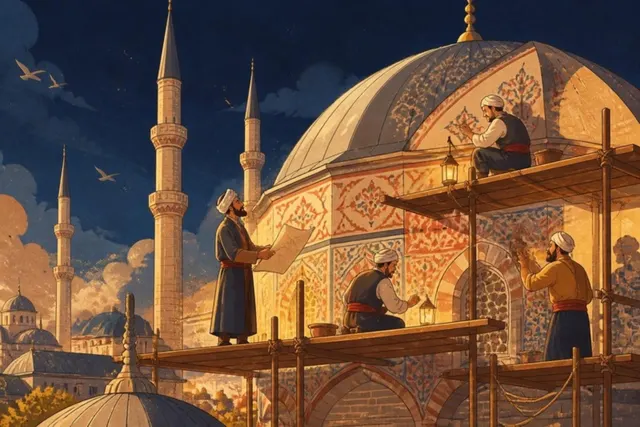
After eighteen months of careful work, the restoration was finally completed. The damaged dome was strengthened using the traditional methods that had been researched so extensively, and the exterior stonework was cleaned without damaging the original carvings. When the was removed, crowds gathered to see the mosque restored to its former glory.
Deniz Hoca, standing among the crowd, felt a deep sense of . "This mosque was built to last for centuries," she said. "Our job wasn't just to fix cracks. It was to make sure that this building will still be admired by people four hundred years from now, exactly as it has been admired until today."

Kelimeler
Hikayedeki 8 yeni kelime, hikayeden örnek cümleleriyle.
Cracks were discovered in one of the mosque's domes.
The project was approved by the heritage authorities.
The mosque was built using stone and specially prepared mortar.
Detailed surveys were conducted by engineers.
Skilled stonemasons were extremely difficult to find.
Crowds gathered when the scaffolding was removed.
Funding was provided through private donations.
Deniz Hoca felt a deep sense of accomplishment.
Gramer notu
passive voice (edilgen çatı)
"Passive voice" (edilgen çatı), eylemi kimin yaptığından çok, eyleme uğrayan şeye odaklanmak için kullanılır: be + fiilin üçüncü hali.
Örnekler:
- Cracks were discovered in one of the mosque's smaller domes.
- Detailed surveys were conducted by a team of engineers.
- The damaged dome was strengthened using traditional methods.
Ne kadar anladın?
5 kısa soru. Cevabını seç, hemen doğrusunu gör.