

The Village That Moved
Taşınan Köy
Bir baraj projesi nedeniyle sular altında kalan tarihi bir köyün yeniden inşa edilme süreci.
Altı noktalı kelimelere dokun, anlamı çıksın.
For thousands of years, the ancient town of Hasankeyf was built along the banks of the Tigris River, its caves and stone buildings directly into the surrounding cliffs. When a large hydroelectric dam project was approved by the government, however, the entire town faced a fate that had once seemed unimaginable: it would eventually be beneath the rising waters of a new reservoir.
Before construction began, extensive archaeological surveys were conducted throughout the region. Ancient artifacts, some dating back thousands of years, were carefully and documented by teams of historians and archaeologists. Certain historically significant structures, including an ancient mosque and several important tombs, were selected to be physically to higher ground, a process that required extraordinary engineering precision.
Meanwhile, the town's residents, many of whose families had lived in this exact location for countless generations, were offered new homes in a specially constructed settlement called New Hasankeyf, built on elevated land nearby. Fatma Hanım, an elderly resident whose family had lived in Hasankeyf for as long as anyone could remember, was among those relocated during this difficult transition.
"Our old house was carved into the mountain itself," she explained to a visiting journalist. "That kind of home cannot simply be rebuilt somewhere else." She was given a modern apartment in the new settlement, equipped with electricity and running water, comforts that hadn't always been available in her original cave dwelling. Yet something essential, she felt, had been lost in the process.
The relocation of the ancient mosque was considered one of the project's most remarkable engineering achievements. The entire structure, weighing hundreds of tons, was carefully lifted using specialized equipment and was slowly transported to its new location several kilometers away. Engineers explained that if even minor mistakes had been made during this delicate process, damage could have been caused to the centuries-old building.
Not everyone accepted the dam project peacefully. Protests were organized by environmental groups and cultural heritage activists, both locally and internationally, who argued that irreplaceable historical treasures were being destroyed for the sake of electricity production. Petitions were signed by thousands of people worldwide, and several international organizations expressed serious concerns about the loss of such significant archaeological heritage.
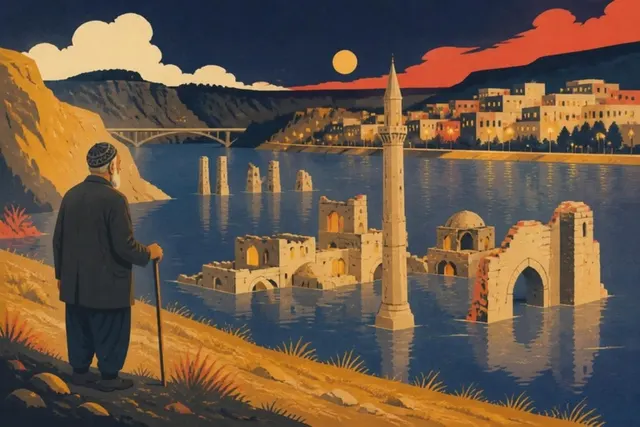
Despite these objections, the dam's construction was ultimately completed, and the reservoir began filling several years ago. Today, most of the original town lies beneath the water, visible only during unusually dry seasons when the water level drops significantly. Underwater diving expeditions have occasionally been organized by researchers, allowing scientists to document what remains of the submerged structures before they deteriorate further.
In New Hasankeyf, life has gradually settled into new routines, though many older residents still describe a persistent feeling of . A small museum was established in the new settlement, where photographs and artifacts from the original town are displayed, preserving at least some connection to what was lost. School children are regularly taken there on educational visits, ensuring that the town's remarkable history continues to be remembered by future generations.
Fatma Hanım visits this museum occasionally, standing quietly before old photographs of her childhood home. "This building was called Hasankeyf for thousands of years," she once told a group of visiting students. "Even though our houses have been moved, and even though water has covered our streets, our memories cannot be submerged. Those, at least, will always remain exactly where they belong."

Kelimeler
Hikayedeki 8 yeni kelime, hikayeden örnek cümleleriyle.
Buildings were carved directly into the cliffs.
The town would eventually be submerged.
Artifacts were carefully excavated.
Certain structures were selected to be relocated.
Specialized hydraulic equipment lifted the structure.
Irreparable damage could have been caused.
Residents describe a feeling of displacement.
The museum preserves the town's connection to its past.
Gramer notu
passive voice (edilgen çatı)
"Passive voice" (be + fiilin üçüncü hali), özellikle büyük projeleri, resmi kararları ve sonuçları, kim yaptığından bağımsız olarak anlatmak için sıkça kullanılır.
Örnekler:
- The entire town faced a fate: it would eventually be submerged beneath the rising waters.
- Extensive archaeological surveys were conducted throughout the region.
- A small museum was established in the new settlement.
Ne kadar anladın?
6 kısa soru. Cevabını seç, hemen doğrusunu gör.