

A Painter's Forgotten Painting
Bir Ressamın Unutulan Tablosu
Bir müzayede evinde bulunan imzasız bir tablonun, unutulmuş bir ressamın hikayesini yeniden gün yüzüne çıkarması.
Altı noktalı kelimelere dokun, anlamı çıksın.
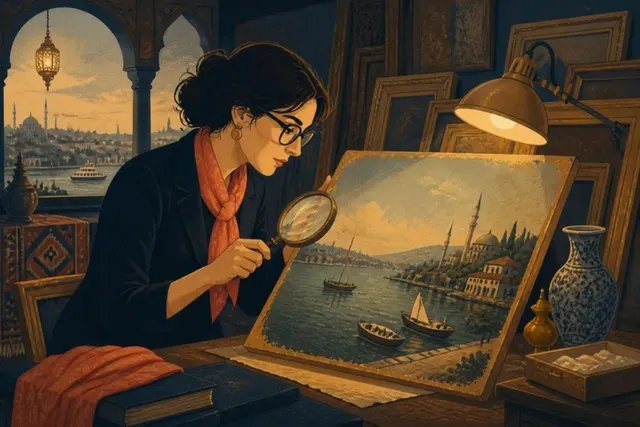
When art Ceyda Hanım was asked to evaluate a collection of paintings that had been donated to a small Istanbul museum, she hadn't expected one particular , unsigned and covered in decades of dust, to consume the next six months of her professional life.
The painting depicted a quiet street scene in old Istanbul, rendered with a technique that seemed considerably more advanced than typical amateur work from its era. It had been sitting in the museum's storage for over forty years, having been donated by a family who apparently knew nothing about its origins beyond the fact that it had belonged to their grandfather.
Ceyda was informed by the museum's records that the painting had originally been simply as "Unknown Artist, mid-twentieth century," a label that had discouraged any serious research into its background for decades. If a more curious appraiser had examined it earlier, she later reflected, this mystery might have been solved long before it landed on her desk.
Using specialized imaging technology, Ceyda discovered faint traces of a signature that had been deliberately painted over, as though the artist themselves had wanted to remain anonymous. This detail her deeply, since most painters of that period had been eager for recognition rather than avoiding it.
She contacted several art historians specializing in Turkish painting from that era, and one of them suggested that the style closely resembled the work of a little-known artist named Rifat Sami, who had reportedly stopped painting entirely sometime in the 1950s under circumstances that had never been fully explained.
Digging through old newspaper archives, Ceyda found a brief article reporting that Rifat Sami had once been a promising art student before disappearing from public life following a scandal involving accusations, later proven false, that he had another artist's work. It was reported at the time that he had been so by the accusation that he had vowed never to sign another painting again.
Ceyda was told by a distant relative of Rifat Sami, whom she eventually managed to track down, that the family had always known he continued painting privately after the scandal, but that he had insisted his work never be shown publicly during his lifetime, still bitter about how unfairly he had been treated by the art community.
The relative explained that if Rifat Sami's had been properly restored while he was still alive, he might have eventually returned to public exhibition, but the damage to his confidence had simply been too severe to overcome. He had passed away in the 1980s, having painted quietly and anonymously for decades, apparently gifting or selling unsigned works to people who had no idea of their true creator's identity.
This discovery transformed how the museum, and eventually art critics more broadly, viewed the painting. What had once been dismissed as simply competent amateur work was now recognized as a significant piece by an artist whose reputation had been unjustly destroyed by false accusations nearly seventy years earlier.
The museum decided to organize a small exhibition dedicated entirely to rediscovering Rifat Sami's work, tracking down other unsigned paintings that had been quietly circulating among private collectors for decades, many of whom had no idea their paintings held such historical significance. Ceyda was asked to the exhibition personally, given her role in uncovering the artist's true identity.
At the exhibition's opening, Ceyda told a gathered crowd of journalists and art enthusiasts that this project had taught her something important about how easily a person's could be erased by a single false accusation, and how much quiet talent might still be waiting, unsigned and forgotten, in attics and storage rooms across the country.

Kelimeler
Hikayedeki 9 yeni kelime, hikayeden örnek cümleleriyle.
Art appraiser Ceyda Hanım.
One particular canvas, unsigned.
It had been catalogued as "Unknown Artist."
This detail intrigued her deeply.
Accusations that he had plagiarized another artist's work.
He had been so humiliated by the accusation.
His reputation had been unjustly destroyed.
She was asked to curate the exhibition.
How easily a legacy could be erased.
Gramer notu
Past perfect, passive voice, third conditional ve reported speech
Past perfect, olaydan önce gerçekleşenleri anlatır: "The painting had been sitting in storage for over forty years." Passive voice: "The signature had been deliberately painted over." Third conditional: "If a more curious appraiser had examined it earlier, this mystery might have been solved long before." Reported speech: "Ceyda was told by a distant relative that the family had always known he continued painting privately."
Ne kadar anladın?
6 kısa soru. Cevabını seç, hemen doğrusunu gör.