

The Archaeologist at Göbeklitepe
Göbeklitepe'deki Arkeolog
Arkeolog Dr. Pınar Aydın'ın Göbeklitepe'de yaptığı çığır açan keşif ve bunun getirdiği ün karşısındaki tutumu.
Altı noktalı kelimelere dokun, anlamı çıksın.
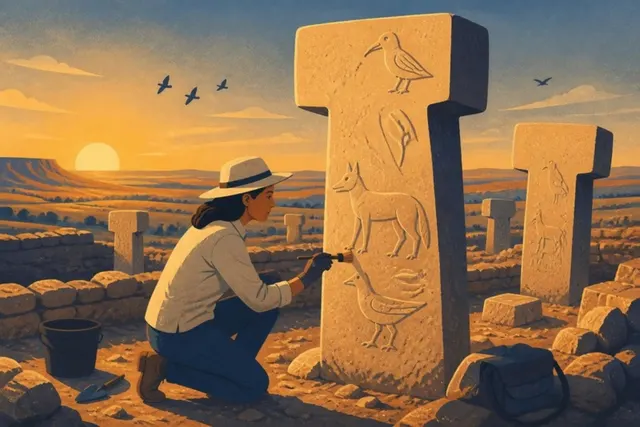
Dr. Pınar Aydın had been working at the Göbeklitepe site for almost fifteen years when she finally discovered something that would change everything she thought she knew about the ancient site. It was a warm morning in early September, and she had been carefully brushing away soil from a large stone when her assistant called her over urgently.
The pillar, it turned out, had that hadn't been documented anywhere before: strange symbols arranged in a pattern that reminded her of something she had once read about in an old research paper, decades earlier. If she hadn't remembered that specific paper, she later admitted, she might have dismissed the symbols as simple decoration and moved on to another section of the site.
Pınar had studied archaeology because, as a child, she had been fascinated by a documentary about ancient that her father had shown her. She used to tell people that she had known, even then, that she would spend her life digging through history, trying to understand how people who lived thousands of years ago had thought and lived.
When she reported her discovery to the site director, he was told immediately that this could be one of the most findings at Göbeklitepe in the past decade. International experts were contacted that same week, and within days, journalists from several countries had already begun requesting interviews with her team.
During one interview, a journalist asked Pınar what she would do if the symbols turned out to be nothing more than random markings, without any deeper meaning. She answered honestly that even then, the discovery would still be valuable, because every piece of information helped build a more complete picture of the past, whether or not it matched their expectations.
As weeks passed, a team of international researchers was to study the carvings more closely. Advanced , which hadn't even existed when Pınar had begun her career, was used to create detailed three-dimensional models of the pillar. She admitted that if she had been given this technology when she was younger, her research would have progressed much faster.
One evening, while reviewing the scans alone in her tent, Pınar realized that the pattern on the pillar seemed to represent a system, something far more advanced than anyone had previously believed people from that era could have created. She immediately called her colleague, who had already gone to bed, and told him that he needed to come back to the site right away.
News of the discovery spread quickly, and soon, Göbeklitepe was being discussed in newspapers and universities around the world. Pınar was invited to give on several continents, something she had never expected when she first arrived at the site as a young, inexperienced researcher fresh out of university.
Despite the sudden attention, Pınar insisted on returning to the excavation site as soon as her lecture tour ended. She told a reporter that if she had chosen fame over , she wouldn't be the archaeologist she had always dreamed of becoming. For her, the greatest reward wasn't , but the quiet satisfaction of uncovering, piece by piece, stories that had been buried for over ten thousand years.

Kelimeler
Hikayedeki 12 yeni kelime, hikayeden örnek cümleleriyle.
She had been working at the excavation site.
She had been brushing soil from a stone pillar.
The pillar had carvings that hadn't been documented.
A documentary about ancient civilizations.
One of the most significant findings.
A team of international researchers was assembled.
A team was assembled to study the carvings.
Advanced scanning technology was used.
The pattern seemed to represent a calendar system.
Pınar was invited to give lectures.
She insisted on returning to fieldwork.
The greatest reward wasn't recognition.
Gramer notu
Past perfect, passive voice, third conditional ve reported speech
Past perfect, bir olaydan önce gerçekleşen durumu anlatır: "Advanced scanning technology, which hadn't even existed when Pınar had begun her career..." Passive voice, eylemi yapanın değil eylemin kendisinin önemli olduğu durumlarda kullanılır: "International experts were contacted that same week." Third conditional, geçmişte gerçekleşmeyen bir durumu ve hayali sonucunu anlatır: "If she had been given this technology when she was younger, her research would have progressed much faster." Reported speech: "She told a reporter that if she had chosen fame over fieldwork, she wouldn't be the archaeologist she had always dreamed of becoming."
Ne kadar anladın?
6 kısa soru. Cevabını seç, hemen doğrusunu gör.